



Vaccinate only when necessary
Aug 3, 2022
"Vaccinate as many dogs as possible, but only as often as necessary
." "Vaccinate as many dogs as possible, but only as often as necessary"—that is the motto of leading veterinary associations such as the World Small Animal Veterinary Association (WSAVA). Vaccines continue to save lives for both humans and animals.
To achieve so-called herd immunity, as many dogs as possible must be vaccinated: To prevent epidemics, we should aim for the highest possible vaccination coverage in the dog population (at least 70%). While this can be achieved through awareness campaigns, the “vaccinate only as needed” aspect is just as important. And this is where in-house antibody tests like the Fassisi® CantiCheck MPX come into play.
Tailored Vaccination Protocols
According to the WSAVA Vaccination Guidelines Group, the “necessary” or so-called core vaccinations for dogs include vaccinations against the canine distemper virus (CDV), the adenovirus (CAV types 1 and 2), and parvovirus (CPV)¹. Tailored vaccination protocols are crucial: The veterinarian should work with the dog owner to develop a tailored vaccination protocol. What is the animal’s age, background, and lifestyle? Does it travel or spend time at a boarding facility? Is it used for breeding, shows, or competitions? Regardless of their lifestyle, all dogs need these so-called core vaccines, which are defined by the WSAVA as those that “all dogs worldwide should receive for protection against infectious diseases of global significance.” In addition, depending on the dog’s lifestyle, non-core vaccines may also be administered.
Core Vaccines: No More Than Once Every 3 Years
However, even core vaccines should not be administered unnecessarily. According to the WSAVA, they should not be administered more frequently than once every three years after the initial vaccination series, which includes the first booster after the puppy series. The reason for this is simple: the duration of immunity (DOI) is many years and can last until the end of the animal’s life.
For core vaccines, the WSAVA guidelines state that the presence of antibodies—regardless of titer—indicates protective immunity and immunological memory. They even emphasize that “administering vaccines to animals more frequently in an attempt to increase antibody titers is a futile practice.”
In-house Antibody Tests: When Should They Be Used?
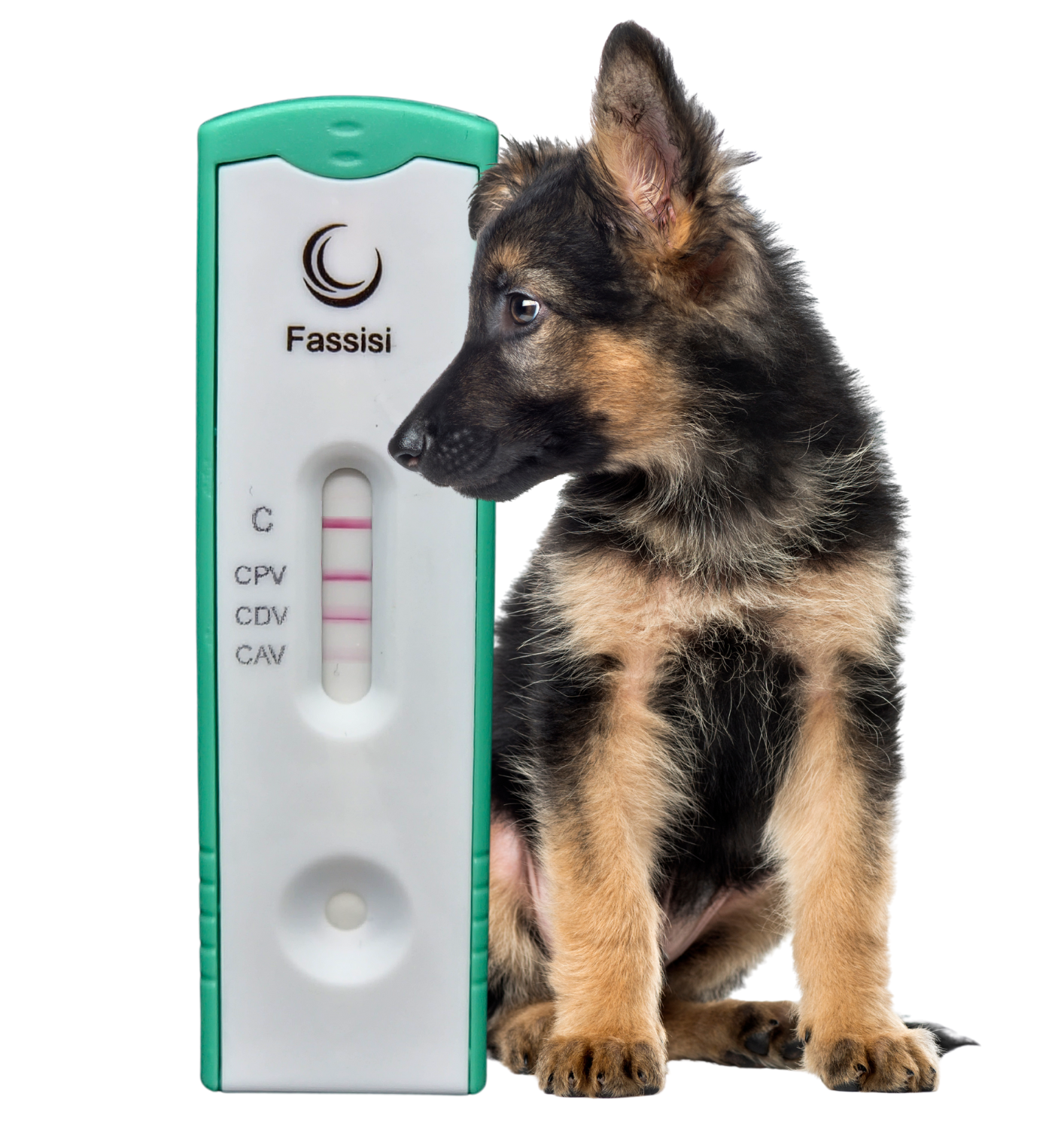
The detection of antibodies against the main components of the vaccine (CDV, CAV, CPV) is therefore a useful tool for determining immune protection, and the use of in-house tests is supported by the WSAVA guidelines. Ideal tests are fast—they provide results within minutes—and give a simple “yes/no” answer, such as the Fassisi® CantiCheck MPX, which detects the presence of CDV, CAV, and CPV antibodies.
This test has several applications:
- to assess protective immunity in puppies
- to determine the immune status of dogs
- when managing outbreaks of infectious diseases in animal shelters
- in the event of adverse events
Is my puppy safe? Measuring Vaccine
Uptake According to WSAVA guidelines, the third dose of core vaccines should be administered at 16 weeks of age or older. Testing puppies at 20 weeks of age identifies which puppies are seropositive and therefore protected. Seropositive puppies do not require a booster vaccination at 26 or 52 weeks and can receive their next booster vaccination 3 years later.
Seronegative puppies should be revaccinated and retested to ensure they can develop protective immunity. Those that do not respond after the booster vaccination may be either “low responders” or genetically determined “non-responders” who are unable to mount an immune response to the antigenic component of the vaccine. Such animals are rare, but certain breeds, such as the Rottweiler, are predisposed to developing a less effective immune response to CPV and the rabies virus.
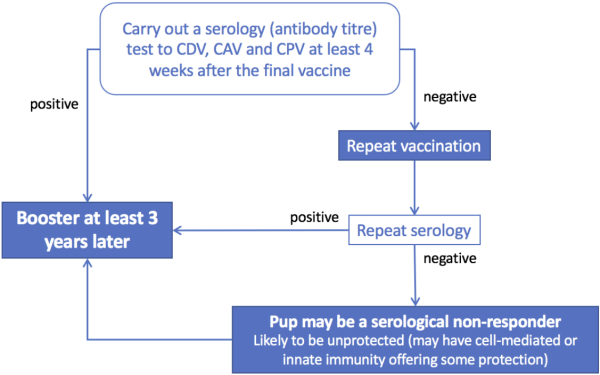
Flowchart for the serological testing of puppies (source: WSAVA)
Whether and When to Vaccinate: Determining Immune Status
Another indication is to determine the immune status of a newly adopted dog with an unknown vaccination history—or even a dog that has not been vaccinated for some time. Most vaccinated dogs retain their protective antibodies against CDV, CPV, and CAV for many years. This means that dogs should only be revaccinated if these antibodies are absent. Testing for antibodies against other vaccine components is of limited use, as these antibodies have only a short “half-life” or there is no correlation between antibody titers and protection (e.g., Leptospira).
Many veterinary practices that have adopted the “annual health checkup” routinely offer serological testing instead of a booster every three years. Pet owners appreciate this option, and it also makes more sense to determine whether a core vaccine is necessary than to administer a vaccine unnecessarily. While an “antibody test” every three years is sufficient for adult animals, an annual test is recommended for dogs over 10 years of age.
Is this rescue dog protected against distemper and other potentially dangerous diseases?
There is only one way to determine the protection status of a dog with an unknown vaccination history—or even a dog whose vaccinations have “expired”—and that is through a serological test such as the in-house rapid test Fassisi® CantiCheck MPX.
Who is protected and who isn’t? Managing outbreaks of infectious diseases
In-house serological tests have revolutionized veterinarians’ ability to combat outbreaks of infectious diseases in animal shelters—particularly CDV or CPV outbreaks. All animals in the shelter should be tested. If the animals are seropositive, this means they are protected. Seronegative (susceptible) animals should be isolated and vaccinated. They should not be released from the shelter until the incubation period for the infection and seroconversion have elapsed (2 weeks for CPV, 6 weeks for CDV). Animals from outside the shelter that must be admitted during an outbreak should also be tested. Seropositive (protected) animals can be safely admitted to the shelter and housed with other seropositive dogs; however, seronegative animals should be vaccinated and placed in foster homes until they have seroconverted.
In the Event of Adverse Events: When Should Vaccines Be Avoided?
If an adverse event has occurred in an animal following vaccination, serological testing can be used to determine whether a core vaccination is necessary. If there is suspicion that the vaccination is a triggering factor for an adverse event—such as in the case of an immune-mediated disease—vaccination should be avoided whenever possible. As long as dogs remain seropositive for CDV, CAV, and CPV, no booster vaccination is necessary. The use of non-core vaccines in such dogs should be carefully considered.
In-house rapid tests such as the Fassisi® CantiCheck MPX can help determine a dog’s immune status against CDV, CPV, and CAV and reduce the frequency of unnecessary vaccinations.
The Most Important Vaccines at a Glance
According to the WSAVA, core vaccines are those “that all dogs worldwide should receive to protect against infectious diseases of global significance.” Let’s take a closer look at the diseases against which we need to protect our pets:
Canine parvovirus (CPV) is a highly contagious virus that can cause acute gastrointestinal disease in dogs. There are currently three variants: CPV-2a, CPV-2b, and CPV-2c. The original CPV-2 variant is rarely isolated today. The most recent variant is CPV-2c, and this genotype is widespread in North and South America, Europe, Africa, and Asia. Parvoviruses are highly pathogenic and infectious, and all three variants of the virus can survive in the environment for up to several months.
The disease most commonly affects puppies between six and 20 weeks of age, but older animals can also be affected. Typical clinical symptoms of CPV include sudden onset of high fever, vomiting, and hemorrhagic diarrhea. In puppies, CPV can also affect the bone marrow, lymphoid tissue, and heart muscle. The disease is potentially fatal. Treatment is not always successful
. The disease is preventable through vaccination. The current WSAVA guidelines recommend vaccinating puppies between 6 and 8 weeks of age with modified live virus (MLV) vaccines, followed by booster doses every 2 to 4 weeks until they are 16 weeks old. After that, a first booster vaccination should be given at 6 months or 1 year of age, followed by no more than one booster every 3 years.
Canine adenovirus type 2 (CAV-2) is related to the hepatitis virus or canine adenovirus type 1. CAV-2 is used in vaccines to protect against infectious canine hepatitis (ICH) and infectious tracheobronchitis. The Virus
In puppies, ICH can cause fever, depression, swelling of the head and neck, and jaundice. In severe cases, ICH can be fatal. In mild cases of ICH, dogs may show a loss of appetite, lethargy, and a low-grade fever. In some dogs, one or both corneas may become cloudy one to two weeks later (a condition known as “blue eye”). Dogs may also show signs of respiratory disease (coughing, nasal discharge).
Vaccination is highly effective in preventing the disease. Parenteral CAV-2-MLV vaccines are recommended for the prevention of ICH and for reducing respiratory diseases associated with CAV-2 infection. Intranasal CAV-2 vaccines are not intended to protect against ICH, but only to prevent respiratory diseases.
Current WSAVA guidelines recommend that puppies be vaccinated at 6 to 8 weeks of age, followed by vaccinations every 2 to 4 weeks until they are 16 weeks old. After that, a first booster vaccination should be given at 6 months or 1 year of age, followed by no more than one booster every 3 years.
The canine distemper virus (CDV) is a morbillivirus that causes distemper (hard-pad disease, soccer ball disease) in dogs. The virus causes immunosuppression and affects multiple body systems, including the gastrointestinal, respiratory, and nervous systems. Clinical symptoms vary widely and include high fever, vomiting and diarrhea, nasal discharge, dehydration, excessive salivation, coughing and/or labored breathing, anorexia, and weight loss. Central nervous system signs can range from twitching, seizures, circling, and ataxia to paralysis. The disease is often fatal. Dogs that survive often develop hyperkeratosis on their paw pads and nose and may suffer from nervous system degeneration.
The recommended vaccines are modified live viruses (MLV) and recombinant vector vaccines (rCDV). Current WSAVA guidelines recommend vaccinating puppies at 6 to 8 weeks of age, followed by vaccinations every 2–4 weeks until 16 weeks of age. After that, a first booster vaccination should be given at 6 months or 1 year of age, followed by no more than one booster every 3 years.
Not surprisingly, puppy vaccines are often offered as a multivalent core vaccine against all three diseases. Similarly, the Fassisi® CantiCheck MPX is a multivalent core test, as it can help determine the immune status against all three viruses in a single test.
Antibody Titer Tests in Practice: Frequently Asked Questions
Are serum antibody titers useful for determining vaccine-induced immunity?
Yes. The WSAVA guidelines emphasize that this “applies in particular to CDV, CPV-2, and CAV-1.” However, serum antibody titers are “of limited or no value for most other vaccines.”
How long should I wait after the CPV-2/CDV vaccination before performing an antibody test at the clinic?
It depends: If a puppy receives its last primary vaccine at 16 weeks of age, it can be tested starting at 20 weeks of age. Any antibodies present at that time cannot be of passive, maternal origin and therefore indicate that the puppy is actively protected.
In adult vaccinated dogs, serum antibodies are likely already present at the time of the booster vaccination, regardless of how much time has passed since the last vaccination.
Can antibody tests such as the CantiCheck MPX be used to detect the presence of maternal antibodies and determine the timing of the first vaccination?
Theoretically, yes. However, it would be very difficult and expensive to repeatedly sample and test young puppies to monitor the decline in maternal antibodies. Therefore, the WSAVA recommends administering vaccinations at repeated intervals starting at about 6–8 weeks of age and continuing until 16 weeks of age to close the so-called immunity gap.
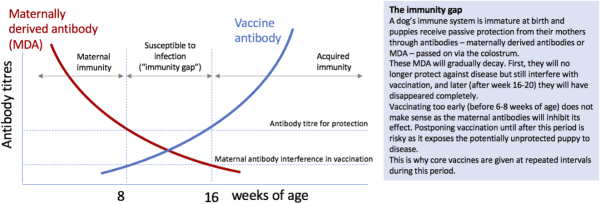
What happens to the antibody titer over a period of 3 years after vaccination?
For CDV, CAV-2, and CPV-2, the antibody titer remains “consistently at a similar level” according to WSAVA guidelines. This has been demonstrated in numerous serological field studies of dogs last vaccinated up to 9 years ago and in experimental studies of dogs last vaccinated up to 14 years ago. For other vaccines, such as Leptospira, titers decline rapidly after vaccination.
Can dogs be tested as an alternative to annual vaccination?
Yes, of course. Validated serological test kits used in clinical practice, such as CantiCheck, help determine the presence of protective serum antibodies specific to CDV, CAV, and CPV-2. In some countries, such kits are used to confirm protection every 3 years instead of an automatic booster vaccination for the most important diseases. If you collect and test samples in your practice, you will quickly find that annual testing is not warranted.
References
- Day MJ et al. Guidelines for the vaccination of dogs and cats compiled by the Vaccination Guidelines Group (VGG) of the World Small Animal Veterinary Association (WSAVA). JSAP (2016) Vol. 57
- Day MJ. The role of serology in vaccination decision-making. WSAVA Congress Proceedings, 2017