




Bovine PAG / Pregnancy (Cattle)
Pregnancy-associated glycoprotein (PAG) belongs to a large group of glycoproteins that are synthesized in binucleated trophoblast cells during pregnancy and released into the maternal bloodstream during fusion with uterine epithelial cells (Zoli, 1991; Wooding, 1992). According to Green, there are more than 100 PAG genes in the bovine genome, of which 21 have been definitively identified to date (Green et al., 2000). Although the function of PAGs has not yet been fully elucidated, it has been demonstrated that the detection of PAGs in maternal blood is a highly specific and reliable parameter for pregnancy diagnosis and monitoring.
The advantage of PAG testing over progesterone testing is that PAG is produced by an intact trophoblast and thus provides direct evidence of pregnancy.
As soon as the embryo implants in the uterus, this is communicated to the mother’s organism via signaling molecules. These signaling molecules—the various pregnancy-associated glycoproteins—are produced in the placenta, enter the cow’s bloodstream, and can thus be measured. Between days 30 and 35 after insemination, pregnancy can be confirmed by measuring PAG-1 (pregnancy-associated glycoprotein-1). Reliable confirmation is possible after day 40. It has been established that the detection of PAGs represents an alternative to the previously established RIA and can therefore be used as a method for detecting and monitoring pregnancy. (M. Friedrich and W. Holtz, 2009).
The discovery of pregnancy-associated glycoproteins (PAGs) represented a revolution in bovine reproductive technology from both a scientific and an economic perspective. The concentration of PAGs increases significantly in maternal blood from day 24 to day 28 post-conception. This makes it possible to diagnose pregnancy even in the early stages of gestation. As early as day 28 after insemination, glycoproteins were detected in the majority of the animals examined in this study (between days 30 and 35 in all animals). (Z. Gajewski et al., 2009)
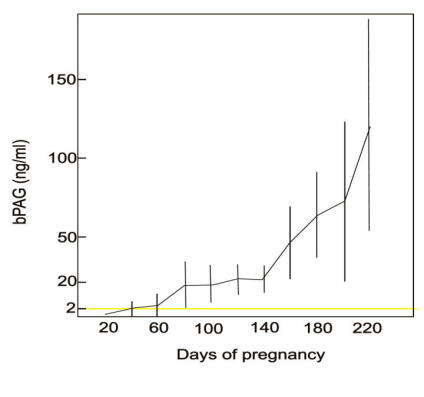
The PAG concentration increases over the course of pregnancy. As shown in the graph, it rises above the 2 ng/mL threshold on average starting around day 28 and continues to increase. It is important to note that PAG concentrations can vary from animal to animal. The validation study demonstrated that reliable pregnancy diagnoses can be made using the Fassisi® BoviPreg after the 30th day following breeding. This supports efforts to shorten the calving interval. It is recommended to perform a follow-up test after eight weeks to confirm the results, as up to 35% of animals may lose the embryo by the 70th day after insemination.
Pregnancy-associated glycoproteins (PAG) are glycoproteins produced in the binuclear cells of the trophoblast of the bovine placenta and released into the maternal bloodstream. They can be detected in the mother’s serum and milk and reflect the presence of an intact, functional trophoblast. Since PAGs originate directly from the trophoblast, their detection serves as a direct indicator of pregnancy, in contrast to the indirect, corpus luteum-dependent measurement of progesterone.
The PAG concentration in maternal blood rises significantly from approximately days 24 to 28 after conception, thereby enabling pregnancy diagnosis in the early stages of pregnancy. Over time, a temporary decrease occurs around day 60, before the concentration rises continuously from mid- to late pregnancy and reaches its peak around the time of birth.
From a diagnostic standpoint, the early identification of pregnant and non-pregnant animals enables efficient reproductive management: Non-pregnant animals can be re-inseminated early, thereby shortening the intercalving interval. Since glycoprotein concentrations can fluctuate for various reasons and early embryonic losses can occur, a confirmatory test later in pregnancy is advisable.
The Fassisi® BoviPreg detects pregnancy-associated glycoprotein (PAG) in the serum or plasma of the dam and supports early pregnancy diagnosis and monitoring in cattle.
Sources for the information provided.
Animal Types

Cow/Calf