





Lyme Disease in Ticks
The clinical presentation of Lyme disease in animals—such as dogs and horses—is just as varied as it is in humans.
In animals, after initial symptoms such as lethargy and fever, the main symptoms are lameness, pain, other signs of dysfunction, and—as long-term effects—joint problems. Isolated or recurring episodes of fever, lethargy, loss of appetite, lameness, and swollen lymph nodes are common.
It is currently still impossible to clearly define a precise clinical picture of borreliosis in animals. Due to these diverse symptoms, an accurate diagnosis is extremely important.
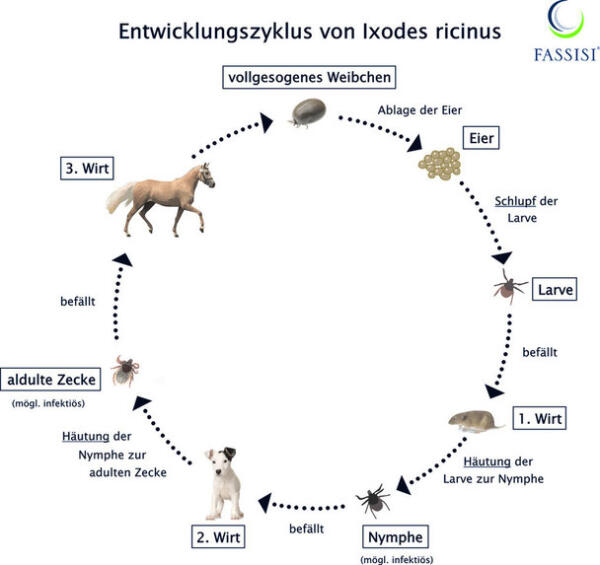
The causative agents of Lyme borreliosis are spirochetes of the Borrelia burgdorferi sensu lato complex. In Europe, the genospecies Borrelia burgdorferi sensu stricto, B. garinii, B. afzelii, and B. spielmanii. The spirochetes colonize the midgut of the tick and only enter its salivary glands during the feeding process.
The vector in Europe is the common wood tick (Ixodes ricinus). Transmission of Borrelia to the host generally requires the tick to remain attached for an extended period, since the pathogens must first migrate from the midgut to the salivary glands before they are transferred to the host. The risk of transmission therefore increases with the duration of the feeding, and early, complete removal of the tick reduces it.
In animals, the majority of infections are subclinical. If clinical disease occurs, the main symptoms are lameness due to polyarthritis, fever, lethargy, loss of appetite, and swollen lymph nodes. The clinical signs are nonspecific; there is no pathognomonic feature.
A Borrelia-positive result from the tested tick confirms that this tick carried Borrelia. It does not prove that transmission to the animal or an infection has occurred, since not every Borrelia-carrying tick transmits the pathogen, and transmission depends on the duration of feeding. Testing the removed tick therefore serves to assess risk and facilitate early veterinary intervention. Detection of infection and disease in the animal itself is performed through clinical examination and antibody testing.
The Fassisi® BoTick detects Borrelia antigens in the removed tick; the sample is the tick, not the animal. It detects the genospecies relevant in Europe: Borrelia burgdorferi sensu stricto, B. garinii, B. afzelii, and B. spielmanii. The result indicates whether the tested tick carried Borrelia; it does not indicate whether transmission or infection of the animal has occurred.
The technical details are documented on the Sources page.
Animal Types

Tick