




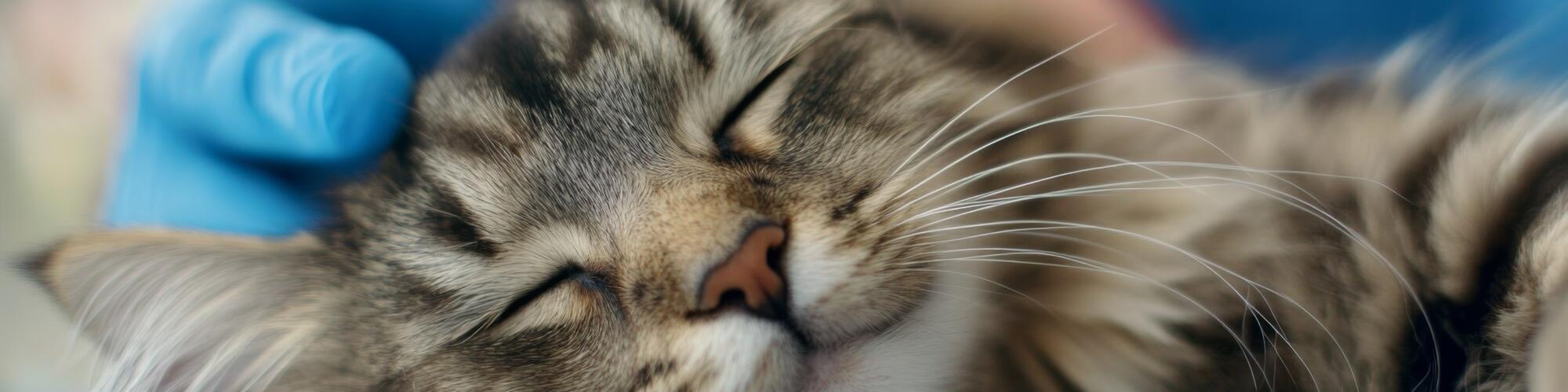
FeLV & FIV
Infections with the feline leukemia virus (FeLV) and the feline immunodeficiency virus (FIV) are common viral diseases that damage cats’ immune systems.
The Feline Immunodeficiency Virus (FIV), like the Feline Leukemia Virus (FeLV), belongs to the class of retroviruses. The difference is that FeLV belongs to the oncornavirus subfamily, while FIV belongs to the lentivirus subfamily. FeLV and FIV can cause similar clinical presentations; symptoms such as a poor coat, persistent fever, and loss of appetite are common. A distinction can be made between clinical symptoms caused directly by FIV—such as neurological symptoms—and those resulting from secondary infections.
| FIV | FeLV | |
| Virus | Lentivirus | Oncovirus |
| Risk group | Middle-aged to older cats, unneutered male cats that go outdoors (rare in indoor-only cats) | Young cats, multi-cat households, and outdoor cats |
| Transmission | Mainly through a bite; transplacental transmission is possible but rare | Close contact; transplacental transmission is common |
| Prevalence | Clinically healthy: 2–3% Clinically ill: 13–19% |
Clinically healthy: 2–3% |
| Immunosuppression | common | frequently |
| Diagnosis (routine) | Antibody detection | Antigen detection |
| Prevention | Vaccination (currently only in the U.S.) | Vaccination |
| Prognosis | Life expectancy is not reduced; cats can live for years without symptoms | 85% of cats with persistent infection die within 3–5 years |
| Clinical Presentation | Stomatitis, neurological symptoms, immune-mediated diseases, secondary infections, increased incidence of tumors | Immune-mediated diseases, secondary infections, aplastic anemia, reproductive disorders, fading kitten syndrome |
The Feline Immunodeficiency Virus (FIV) is widespread worldwide. Like almost all lentiviruses, FIV is primarily cell-associated and remains infectious in the external environment for only a very short time. Transmission occurs through parenteral inoculation of virus-containing cells into the bloodstream of a healthy cat. A bite from an infected cat results in a nearly 100% probability of transmission. It should be noted that antibody production begins no earlier than two weeks after exposure. Initially, env-specific antibodies appear, followed shortly thereafter by gag-specific antibodies.
The feline leukemia virus (FeLV) causes the widespread feline leukemia virus infection, which remains one of the most common causes of death in cats. The incubation period varies from animal to animal. In some cats, the first symptoms may appear just a few days after infection, while in others it may take weeks, months, or years. Retroviruses are transmitted in various ways, e.g., through saliva, nasal secretions, and urine, making them a high risk of infection for other cats. If the virus infects the bone marrow, blood formation is disrupted, leading to anemia and leukemia. The feline leukemia virus (FeLV) is widespread in the feline population and is usually fatal; the risk of infection is very high.
A vaccine is available against the Feline Leukemia Virus; however, a vaccine against the Feline Immunodeficiency Virus is not yet widely available. Based on clinical symptoms alone, it is very difficult to diagnose an FIV or FeLV infection. Simultaneous FeLV and FIV infection is possible.
Due to the similar clinical symptoms, a combined rapid test, such as the Fassisi® FeLFIV, is recommended for suspected cases, as it can individually detect both pathogens using a single rapid test cassette. Cats in uncontrolled multi-cat households and cats with outdoor access are particularly at risk. A combined indirect detection of FIV antibodies with direct antigen detection (FeLV antigen) can be reliably performed in veterinary practice.
For several years now, the diagnosis of FeLV-FIV infections has been routinely performed directly in veterinary practices using immunochromatographic rapid test systems. For this reason, the Fassisi® FeLFIV has been further developed and optimized for daily use in veterinary practice.
FeLV Antigen (p27)
Pathogen and Course
of Infection The feline leukemia virus (FeLV) is a feline gammaretrovirus. The course of infection varies: The immune system may eliminate the virus early (abortive infection), partially suppress viral replication (regressive infection), or the infection may progress with sustained viral replication (progressive infection). The course of the infection determines the prognosis and risk of transmission: cats with progressive infection shed the virus and are at risk of anemia, immunosuppression, and neoplastic diseases, whereas cats with regressive or abortive infections may have a significantly more favorable prognosis.
Diagnostic Relevance
The basic diagnosis of active FeLV infection is based on the detection of free FeLV antigen (p27) in the blood and identifies progressive infection. Since the infection status can change over time, confirmatory testing over the course of the disease is advisable. Antigen and antibody detection shed light on different aspects of the infection and can be combined depending on the clinical question.
Rapid Test Components
The FeLV antigen (p27) is detected by several Fassisi® FeLV rapid tests using serum, plasma, or whole blood: Fassisi® FeLFIV (FeLV antigen combined with FIV antibody), Fassisi® FeLV (FeLV antigen), and Fassisi® Feline Triple (FeLV antigen p27, FeLV antibody p15E, FIV antibody gp40). The tests aid in diagnosis in cases of clinical suspicion, prior to admission into a cattery, and for outdoor cats. The FeLV antibody component of the Feline Triple is described separately (see FeLV Antibodies).
FIV Antibodies (gp40)
Pathogen and Course
of Infection The Feline Immunodeficiency Virus (FIV) is a feline lentivirus that is widespread worldwide. Following infection, fever and swollen lymph nodes may occur temporarily; after which many cats remain clinically unremarkable for months to years before progressive weakening of the immune system predisposes them to secondary infections. With proper care and in the absence of co-infection, FIV-positive cats often achieve a normal life expectancy.
Transmission
: The primary route of transmission is through bite wounds, as the virus is excreted in saliva; outdoor, male, and older cats are at the highest risk. FIV is transmitted only inefficiently through everyday contact, such as sharing food bowls or mutual grooming. Transmission from the mother cat to her kittens is possible.
Diagnostic Relevance
: FIV diagnosis is based on the detection of antibodies, which generally persist for life following infection. Two scenarios must be considered when interpreting results: In kittens, maternal antibodies can lead to a positive result, which may disappear within the first few months of life; an FIV vaccination can also influence the antibody result. A positive result is therefore evaluated in a clinical context and monitored over time if necessary.
The FIV antibody (gp40) rapid test component
is provided by Fassisi® FeLFIV (FIV antibodies combined with FeLV antigen), Fassisi® FIV (FIV antibodies), and Fassisi® Feline RetroPro (FeLV antigen p27, FeLV antibody p15E, FIV antibody gp40) from serum, plasma, or whole blood. Testing is recommended in cases of clinical suspicion, prior to introducing a cat into a multi-cat household, and for cats that go outdoors.
An overview of the sources used can be found here.
Animal Types

Cat